
|
Professional Insect Light Traps (ILTs) © 1986 Revised 1987 - 2002 Donald E. and David W. Gilbert II Over 35 years ago, we discovered that traps placed down low best catch day-flying insects like the housefly. It is the fly's nature to be below five feet (even skimming the floor) when they are most responsive to traps. Since flies are a primary target and tough to catch; a well-designed system, consisting primarily of strategically placed, low, wall-mounted, professional traps is usually the best overall design. However, there are exceptions...
Since 1967, our general rule of thumb has been to space large traps every 40 feet around the inside perimeter wall of a food plant or pharmaceutical laboratory. If you multiply 40 x 40, you get 1600 square feet. However, any square foot coverage estimates are questionable. The distance at which an insect responds is determined by lamp type and trap design, of course, but also by the vision and nature of the target pest. Response distance varies by species, not just trap design. In addition, the number of traps required will vary with the type and condition of the facility, the extent of the problem, and management's level of concern. A facility next to a cow pasture, or an unkempt dumpster, or an older facility not interested in sealing cracks, or one plagued with badly designed dock lighting will need more traps per square foot. A 40' x 40' room (1600 sq. ft.) may need no traps or four traps or more depending on the circumstances. There is no science (no published research) to back square foot claims. They may be helpful in answering novice questions or as a general starting point in designing a flytrap system. You can always add or move a trap later, but they certainly shouldn't be used to compare one brand trap to another, since they are subject to marketing department invention and exaggeration (i.e., No ILT will cover or clear an acre, half-acre, or quarter acre of flying insects).
Visual AcuityGenerally speaking, most insects do not respond to light traps more than a hundred feet away. Houseflies appear to respond at about 20 to 25 feet with a significant increase at about 12 feet**, but more important is the nature of the response.
Nature Of The Fly
Designing A Professional Flytrap SystemWe discovered, long ago, that a system designed well enough to handle houseflies is a good, basic overall system that functions well against a wide range of species. The benefits of such a system are plural and exceptions can be handled with minor strategic adjustments.
Spacing Traps
Spread the first ILTs along the most critical insect pathways, one which leads from a dumpster to a food production area, for example. Good spots for ILTs along these pathways are at entrances, doorways, and other "bottlenecks", especially in vestibules. If there are no vestibules or good bottlenecks between refuse areas and production areas; then at least one should be constructed. ILTs are most effective where insects are routinely detained and given more time to respond.
Mount Traps Down LowIf you want to control flies, install traps down low (below 5 feet). Research shows that a light trap placed waist high or lower is significantly more effective than one placed above 5 feet. Though many flying insects (especially night-fliers) respond better at higher heights in buildings; generally, they come down to traps much better than day-fliers go up to traps. ILTs are also easier to monitor and maintain when they are waist high (no ladder needed). However, there are exceptions, in rooms with unusual temperature stratifications, etc. (See Also: gilbertinc.com/storedpr.htm) Ceiling-hung traps may be needed in circumstances where there is simply no space to mount a trap down low (not a nearby wall or corner or even a post where a trap could be mounted) or, perhaps, in an area plagued with night-flying insects that refuse to be controlled with strategic outdoor lighting and low mounted traps. Such odd situations require large traps, mounted 8 to 10 feet from the floor, perpendicular to and above the door opening, so as not to draw insects in from the outside. There Are Exceptions To The Rule Wall sconce flytraps are useful in hospital hallways, restaurants, fine dining establishments, or other public areas where using an industrial trap design might clash with the decor. Ceiling-hung traps may be needed in areas where the invading insects cannot be controlled with strategic lighting, exclusion, and low, wall mounted traps, where there is simply no space to mount a trap down low, not even a corner where a 601T could be placed. Monitoring of stored product insects is best accomplished at higher heights ?
Exploding MythsSincere consideration should be given to the relatively few richochet insects and microparticles that may fall from ILTs. The emphasis here is on "sincere" consideration. Beware of exaggerated, "Chicken Little... sky is falling!", adverting gimmicks and the questionable research claimed to support it. Gilbert® has long advised customers to practice proper, low, strategic placement of traps. Still, you will find those who have been misled to extreme positions by "exploding" fly sales gimmicks presented as education. Sincere critical thinking is overdue on the issue: See: gilbertinc.com/eltvsgt.htm.
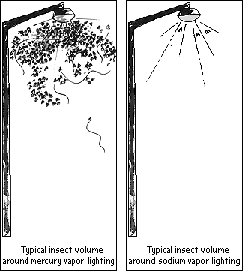
Existing LightingILTs must compete with other light sources for an insects attention. Standard incandescent and fluorescent lighting have little or no effect on pro ILT performance, as long as it is not placed where it draws additional insects into the facility. However, mercury vapor lamps emit enough UV to reduce the effectiveness of light traps. The use of sodium vapor and lower wattage lighting will increase light trap effectiveness. New LED fixtures may even prove to be superior since LEDs can be selectively chosen for output on a nanometer scale
A List Of Don'ts• Do not use ceiling-hung ILTs in food processing areas. Use only low, wall mounted, professional ILTs at low height. And, keep them at least 5ft., preferably 10 ft., perhaps, even 30 ft. away from exposed food and food-contact surfaces, especially if this is easily acheivable. Though our traps are escape-resistant (designed to retain the insect within the device); lightweight insect fragments can, on occasion, bounce or be blown out of any trap, including glueboard traps. This is especially true if glueboards have been forgotten, inadvertantly dried out (it happens). The risk is highest for any type trap while it is being serviced. • Do not use light traps where their attractant light shines directly out open or glass doors after dusk. Outside insects can be attracted in. • Don't forget the ADA requirements when installing traps. • Do not use any electric ILTs in explosion sensitive areas. See the National Electric Code. • Don't forget that UV from ILTs can color-fade wall paper, tile, fabrics, etc. • Do not place ILTs in direct sunlight. Sunlight contains all the wavelengths of energy that both humans and insects see as light, including the wavelengths that attract insects to ILTs. This does not mean that the darkest spot in the room is always the best place for a light trap. • Do not overestimate the ability of light meters; especially, cheap, little ones. If properly used (and that's the crux of the matter); they can distinguish an old lamp from a new one, but "if" and only "if" comparing the exact same brand and model of lamp. METERS ARE NOT FLIES! They cannot evaluate trap designs, the comparative effectiveness of different lamps, or shatter-proof coatings. Only good, honest research with insects can do that. Seen any? Learn as much as you can about the nature of flying insects. Be aware of the effect odor, temperature, wind and light have on them. Use all preventative procedures to keep flying insects at a minimum. No one can fine tune your fly system better than a sincere dedicated thinking person onsite. Our distributor network features just such people. And, experience counts. Call toll-free (800) 643-0400 for strategic installation assistance. Together, we will reason our way to the best coverage for your facility and advance the art and science of ILTs. *Weidhass, D.E.; Hollingsworth, J.P.; Thompson, E.G. & Davis, D.F., 1986. An Evaluation of Electrocuting Light Traps For Fly Control In Buildings. In Gilbert® Sponsored Insect Electrocuting Light Trap Research. Gilbert Industries, Inc. Jonesboro, AR. Pgs. 33-75. *Lillie, Thomas H. and Jerome Goddard. 1987. Operational Testing of Electrocuter Traps for Fly Control In Dining Facilities. Journal of Economic Entomology. Vol 80, No. 4 Pg. 826-829 ** Pickens, Lawrence G., Circa 1983. Unpublished research at USDA facility in Beltsville, MD. Personal communication with the Authors. |

![[spacing.gif]](images/spacing.gif)
 Made in the USA of US and imported parts.
Buy Our Traps, Create US Jobs!
Gilbert Industries, Inc. 5611 Krueger Drive Jonesboro, AR 72401
PHONE: (800) 643-0400 FAX: (870) 932-5609 E-MAIL: mailbox@gilbertinc.com
Site Created: August 1996 Copyright© 1996-Today, Gilbert Industries, Inc.