Gilbert Logo

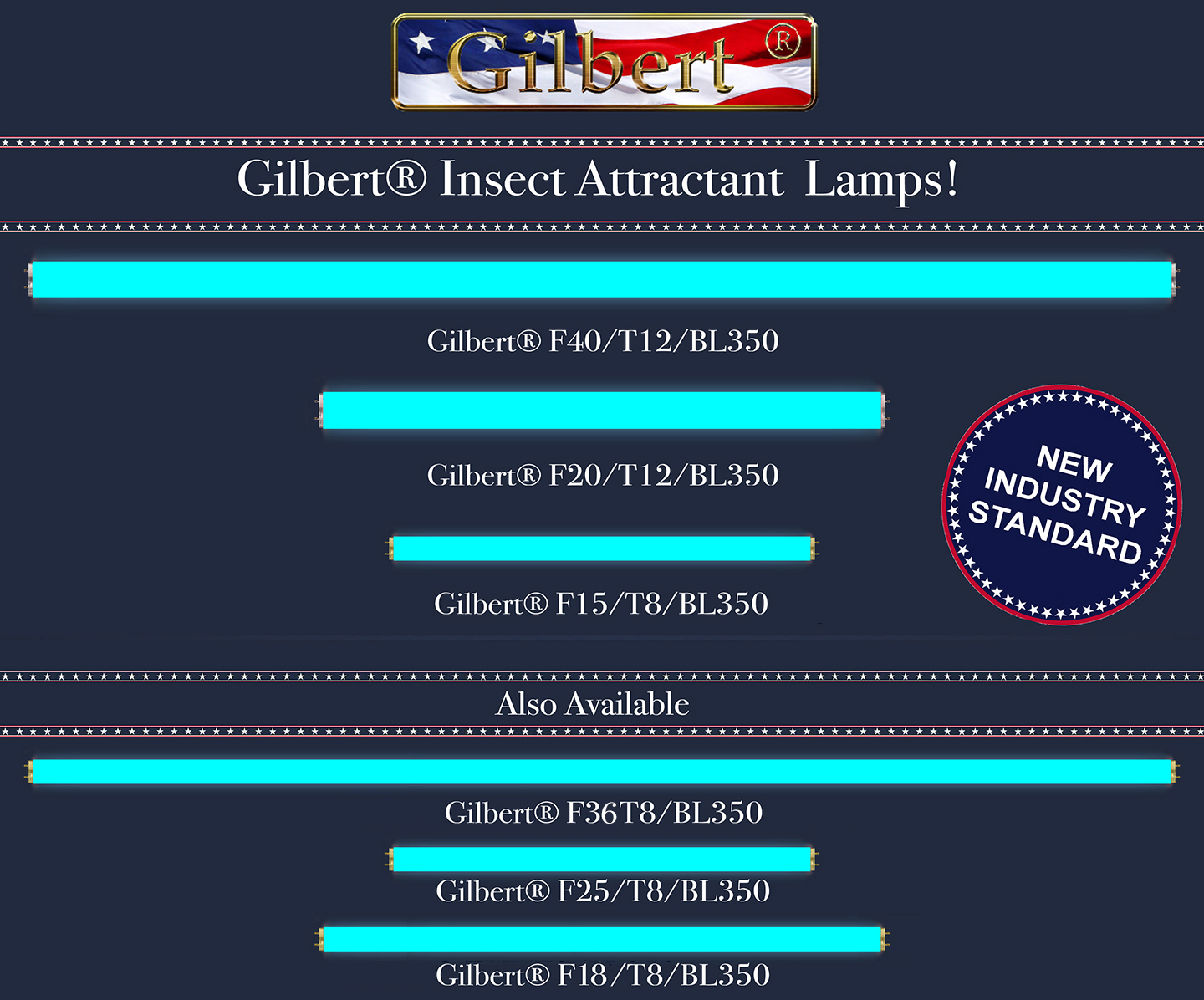
Insect Attractant Lamps
A little over 30 years ago, Don Gilbert discovered the (Osram) Sylvania®
350 BL Phosphor Lamp to be the best lamp for professional flytraps;
That distinction has held true for over three decades.
"


All lamps used in Gilbert® Flytraps pass the federal TCLP test.


Never judge a lamp or a light trap by it's wattage alone.

Notice the difference between "Sylvania®" lamps made in North America (which we use) and "Sylvania®" lamps made in Europe. They are made by two different manufacturing companies, Osram Sylvania® and S.L.I., both still use the "Sylvania®" brand name and "350BL"  phosphor name. The only way to tell the difference is on the label (where it's made). Our tests show the Osram Sylvania® 350BL (Made In North America) 20 and 40 watt versions to be superior fly attractant lamps, especially over time.

Beware of advertising claims being made for european lamps that peak at 365 nm. We believe they have made errors in logic, in their research, and in professional ethics. And, that the misleading advertising is much worse than the lamps. We continue to recommend the North American Sylvania® 350BL (which peaks around 352 nm). Also, beware of claims for BLB lamps.

Gilbert® ShatterCatch® Safety Coated Lamps
(For Glass Containment In Case Lamp Breaks)

Insect Attractant Lamp Replacement Recommendations


Safety Information

The following statement is reprinted from the Gilbert® Professional Flytraps Owner's Manual:

The FDA has measured ultraviolet radiation emission from a typical insect attracting device and has concluded that there is not a significant concern about acute health problems. The conclusion was based on Threshold Limit Values (TLV) of exposure as recommended by the American Conference on Governmental Industrial Hygienists (ACGIH) as presented and discussed by Phillips (1983). However, since it's scientifically impossible to rule out possible long-term exposure effects, on our own accord, as a purely precautionary measure, we suggest it might be prudent for operators to position these devices so that employees are not required to work continuously in close eye level proximity, i.e. over a sink or table where an employee would be stationed within one meter continuously.


Research & Development

29 February, 2000

Mr. David Gilbert, President
Gilbert Industries, Inc.
5611 Krueger Drive
Jonesboro, AR 72401-6818

Dear Mr. Gilbert:

As you requested, I am providing you with information on several of our Blacklight fluorescent lamps. The lamp safety information is based on ANSI/IESNA RP-27.1-96, Recommended Practice for Photobiological Safety for Lamps and Lamp Systems - General Requirements. The criteria are essentially the Threshold Limit Values of the American Conference of Governmental Industrial Hygienists.

The table below covers the Blacklight fluorescent lamps in which you are interested. Radiant power values are based on analysis of lamps sampled in recent years and the known relations between lamps of various types. All measurements were performed at the standard 100 hour initial rating time with the lamp operated on ANSI specified lamp test ballasts. Spacially total radiant power data are given with S() spectral weighting on the 200-400 nm band and for the spectrally unweighted 320-400 nm UV-A band. This 320-400 nm band corresponds to the region for blacklight effects. There are recommended exposure limits based on each of these quantities.

Lamps Radiant Power

UV-A
mW/cm2

S()
µW/cm2

0.3 m Distance

UV-A
mW/cm2

S()
µW/cm2

tmax
hr

0.6 m Distance

UV-A
mW/cm2

S()
µW/cm2

tmax
hr

1.0 m Distance

UV-A
mW/cm2

S()
µW/cm2

tmax
hr

F15T8/350BL
F20T12/350BL
F30T8/350BL
F40T12/350BL

2.9
4.2
7.5
10.6

3.0E-3
4.4E-3
7.7E-3
1.1E-3

0.28
0.35
0.38
0.40

0.29
0.36
0.39
0.41

2-3/4
2-1/4
2
2

0.08
0.11
0.17
0.20

0.09
0.12
0.18
0.20

-
6-3/4
4-1/2
-

0.03
0.04
0.07
0.10

0.03
0.05
0.08
0.10

-
-
-
-

The total spacial radiant power in watts can be used as a basis for calculating irradiance at any point with respect to a lamp. I have calculated irradiance in accord with the ANSI/IESNA criterion, i.e., a maximum incident irradiation of 80º angular extent. The irradiance is at a point on a line through the lamp center and normal to the lamp axis; the elemental area is normal to that line. The evaluations are at 30 cm, 60 cm, and 100 cm distances from the lamp axis. These irradiances can be used to evaluate the exposure limitations defined in the ANSI/IESNA standard.

The UV-A limit for continuous exposure of the eye is 1.0 mW/cm2. All of the blacklight lamps meet this condition even for the smallest distance of 30 cm (approximately 12 inches). The S() weighted limit for eye or skin exposure is 0.003 J/cm2 per 8-hour period. This corresponds to an irradiance of 0.1 µW/cm2. The maximum exposure time (tmax) is calculated from the S() weighted irradiance and is for an 8-hour period. All of these lamps meet the exposure criteria at a one meter distance.

Any application of such data must consider the particular conditions of exposure. Factors could include the cumulative time actually spent at close distances per day, the decrease of lamp emission as the lamp ages, the fact that many commercial ballasts operate lamps below their rating, etc.

The major contribution to the S() summation is in the vicinity of 290 nm to 315 nm. Various materials such as window glass and many plastics will significantly block such radiation with minimal effect on the UV-A blacklight region. Some reflectors will increase the UV irradiance while others highly reflective in the visible are poor reflectors of the shorter wavelength UV.

If you have further questions, please feel free to contact me at any time.


*The Gilbert® preference for North American manufactured Osram/Sylvania® 350BL phosphor lamps is based on Gilbert® Professional Flytrap research.

ShatterCatch® Safety Coated Lamps Info
(For Glass Containment In Case Lamp Breaks)

Insect Attractant Lamp Deterioration

Lamp Replacement Recommendation

LAMP DISPOSAL INFO (OFF-SITE WEBSITES)

Back to More About Gilbert®

Gilbert Industries, Inc. 5611 Krueger Drive, Jonesboro, AR 72401
TOLL FREE: (800) 643-0400 PHONE: (870) 932-6070 FAX: (870) 932-5609
E-MAIL:
mailbox@gilbertinc.com
Site Created: August 1996 Copyright© 1996-Today, Gilbert Industries, Inc.